The Global Proteome Machine Organization The Global Proteome Machine Organization
www.thegpm.org

The gpmDB Project

The Global Proteome Machine Database was constructed to utilize the information obtained by GPM servers to aid in the difficult process of validating peptide MS/MS spectra as well as protein coverage patterns. This database has been integrated into the GPM server pages, allowing users to quickly compare their experimental results with the best results that have been previously observed by users of the machine.

Every effort has been made to anonymize the results used by the gpmDB. If you do not wish your data to be made available in this way, please be sure to click the appropriate box on the search pages.

gpmDB: Design

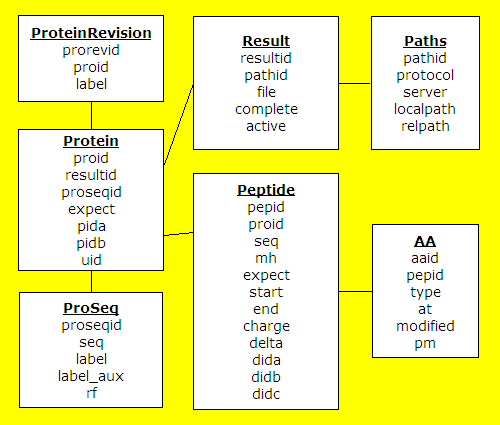
gpmDB was designed to be a simplification and extension of the MIAPE scheme proposed by the PSI committee of HUPO. Rather than being a complete record of a proteomics experiment, this database holds the minimum amount of information necessary for certain bioinformatics-related tasks, such as sequence assignment validation. Most of the data is held in a set of XML files: the database serves as an index to those files, allowing for very rapid lookups and reduced database storage requirements. We call this combination of a relational database with XML data XIAPE (Xml Information About a Proteomics Experiment).

The gpmDB's structure

gpmDB: install your own

All of the scripts necessary to install and operate your own version of the gpmDB are available on our ftp site for download. This database structure can be used as a template for constructing an in-house data storage system, or it can be used as an add-on to an existing LIMS system.

How subsequence (sequence tag) searches workd

The public version of GPMDB has recently updated the way that sequence tag searches are performed (how it works). This new method results in a considerable speed improvement, compared with the older sequence retrieval method. If you want to try it yourself, please use the sequence search page and select the "tag" option once you have typed in your amino acid sequence.


Copyright © 2004, The Global Proteome Machine Organization Privacy Statement